Orality, Literacy, ?
Making sense of the new world we are entering


One of the first things I wrote when I started this little substack for myself in 2023 was on “Writing as Self-Alienation”.

Somehow, someone on the internet found my random substack post and recommended that I read Ong’s Orality and Literacy. 2 years1 later, I’m happy to say I’ve finally read Ong, it was indeed an excellent recommendation, and I have thoughts!
Discourse today about oral and literate culture often frames our current moment as a return to oral culture.2
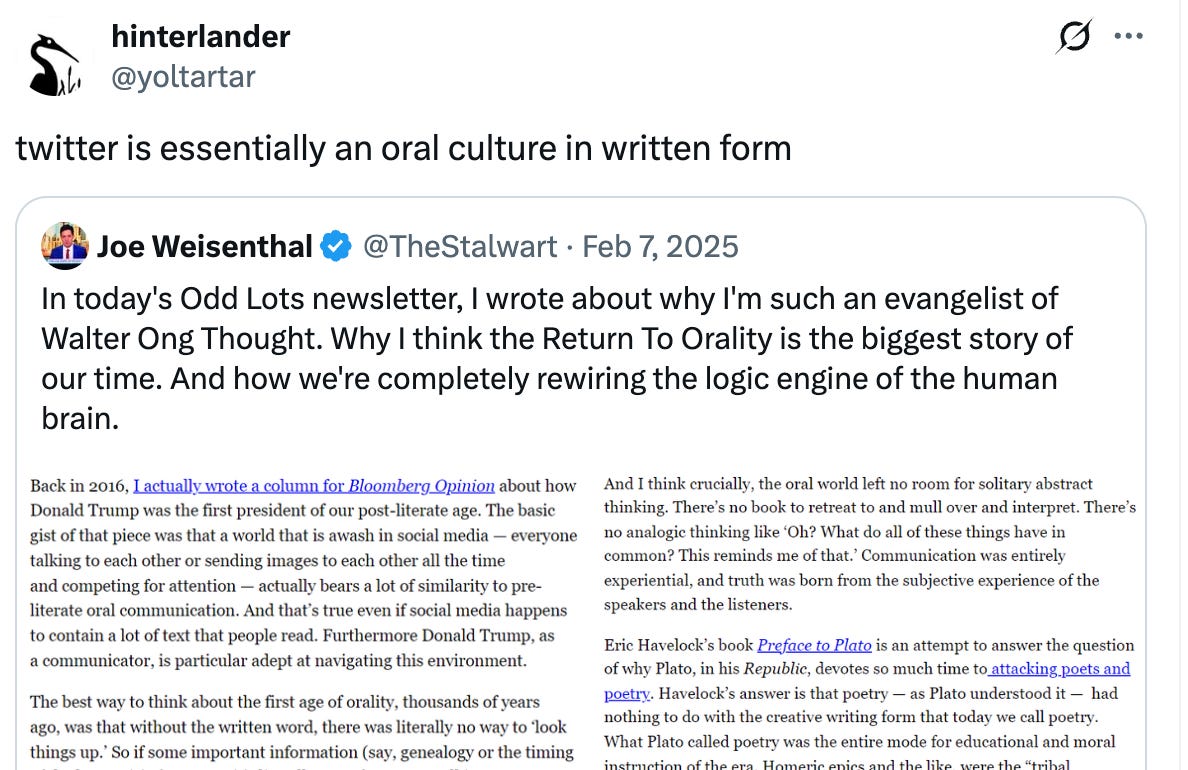
But this framing is an incomplete analysis of where we are headed and more a symptom of a deeply steeped literary world trying to reach for the nearest frame of reference, rather than critically engaging with the new world we find ourselves in.3 We are not returning to oral culture, but entering something new.
This essay follows Ong’s framework through describing oral and literate culture, and then draws out the distinct, post-literate world we are moving into.
Oral
"For [oral] peoples generally language is a mode of action and not a countersign of thought…[tied] with their sense of the word as necessarily spoken, sounded, and hence power-drive. Deeply typographic folk forget to think of words as primarily oral, as events, and hence as necessarily powered.
Walter Ong, Orality and Literacy
The spoken word in oral culture has great power: Adam naming animals in Genesis and the early church practice of giving new names to believers is an example of how oral cultures imbued even the name you were called with great significance. There is a reason the ancients believed in the importance of what you swore by and the violence of curses - it is because their words had power.
Like a lion leaping onto a herd and breaking the neck of a calf or cow as it grazes in a pasture,
so the son of Tydeus harshly forced them from their chariotIlliad Book 5
Oral cultures are also deeply tied to the physical world, which results in a lack of analytical reasoning. Words are deeply powerful, but their very impermanence means they lack hard contours to construct analytical frames around. As a result, they are deeply situational, relying on the physical universe around them to convey meaning e.g. beautiful-in-the-way-a-warrior-ready-to-fight-is-beautiful.
“Sustained thought in an oral culture is tied to communication…think memorable thoughts…something in nonformulaic, non-patterned, non-mnemonic terms…would be a waste of time”
Ong, Orality and Literacy
The impermanence of the spoken word combined with its universality creates patterns and templates, familiar grooves to try to make utterances echo as long as possible in one’s mind, hence why redundancy and repetition are also common in oral culture. Note that these “grooves” and “rhythms” are close to universal, which is why African drum beats and Buddhist vocalizations are so memetically viral in the West: they speak to universal patterns, even for those who do not understand the language. Their return is a recolonization of fallow cultures that have lost touch with oral psychodynamic stimulation.
Because in its physical constitution as sound, the spoken word proceeds from the human interior and manifests human beings to one another as conscious interiors, as persons, the spoken word forms human beings into close-knit groups. When a speaker is addressing an audience, the members of the audience normally become a unity, with themselves and with the speaker.
Ong, Orality and Literacy
Finally, oral culture is deeply participatory and communal. The physical limits to scaling oral culture creates a sense of presence in oral culture between the speaker and the listener. This sense of presence is also why messengers of rulers were treated with great regard. When they travelled and announced the kings edict, they were quite literally, speaking with the voice of the king.
Ong argues that we are so steeped in literary culture we cannot even mentally grasp how foreign oral cultures truly are in their practice, in their thinking, in their social organization. This is precisely why "return to orality" is such a tempting misdiagnosis: we reach for the most familiar Other, without seeking to truly make sense and orient ourselves in this moment of change.
Literate
Sticks and stones may break my bones,
but words will never hurt me
By contrast, literate culture emphasizes the written word, which is static, externalized, and permanent. The very permanence of writing, which externalizes and captures thought, enables abstract reasoning. Jac Mullen describes this dynamic well, of literate culture providing “deep interiority” of thought. But this same permanence disenchants words (and the rituals embodied in those words) and instead enables the construction abstract structures e.g. world-building novels, legal reasoning, etc.
Similarly, permanence means that writing is terse and concise, rather than redundant and copious.
Ong notes how long the psychodynamic shift from oral to literate culture took. From Plato’s dialogues, which were essentially fictional oral exchanges recorded in text, to “dear reader” invocations in 18th century novels that still assumed an author speaking aloud, it is only in the past several centuries that literary culture has fully taken root - and only in certain parts of the world.
Of course, the transition from oral culture to literary culture was not only lengthy and uneven, it was also disruptive. Literate culture shifted the locus of meaning from rituals, like indulgences, to the written word, like Scripture. It brought about the protestant reformation, which unleashed spasms of religious violence across Europe for over a century. And arguably, it was only once ideas could be externalized that one could conceive of another person having ideas worth protecting. Liberalism, and the nations it birthed, are literate inventions.
Post-Literate
“It is only now beginning to be understood that cultures may also suffer grievously from information glut, information without meaning, information without control mechanisms”
Neil Postman, Technopoly
If a tree falls in a forest and no one is around to hear it, does it make a sound?
life is a tale told by an idiot,
full of sound and fury,
signifying nothingShakespeare, Macbeth
If literate culture is the movement from the impermanence of oral speech to the permanence of written text, post-literate culture is defined by the impermanence of written text. In a post-literate culture, the feed, one of the key mediums of the age, is constantly moving on to the next tweet or post. While oral cultures “slough off memories” over time i.e. generations, post-literate cultures have breathtakingly short attention spans, with events receding over the horizon within days.4
And rather than being derived from underlying psychodynamics that unite, or enabling the permanent external embodiment of ideas and reasoning, post-literate culture is shaped by what Jac Mullen describes as “The Loom”, by the externalization of our attention. What is remembered, what utterances are elevated, follows some general dynamics (rage-bait, perseverance-porn), but more perniciously it follows the topography of the attention economy itself, which breeds hidden subcultures invisible to one another.
While there is a similar idea of a rhythmic pneumonic in terms of what goes “viral” or a certain twitter speak, it is no longer tied to something as fundamentally human as rhythm or rhyme, but instead to rapidly evolving subcultures. There is no universality anymore: someone from a different generation, a different part of the internet, or even a year from now, will not understand any of the memes that captivate attention today.5
Compared to the redundancy within a speech or African drum talk, or the terseness of literate writing, post-literate culture is characterized by distributed volume: memory is tied not to mnemonics or rhythms, nor to the textual transmission of ideas, but to the sheer repetition of tokens from disparate sources. This acceleration will only continue as token machines represent an increasingly large share of ever-growing text volume.
Attention matters in post-literate culture not for the communion it creates between speaker and listener, as in oral culture, nor for the ideas it transmits, as in literate culture, but because it is convertible into action: into sales, into movements, into political power, into capital. The words of an influencer are hollow except insofar as they actuate: the affiliate link clicked, the candidate voted for, the product purchased.
When literate culture externalized and commodified ideas into text, it created a Renaissance marketplace of ideas - and with it, mass education. Post-literate culture, in commodifying attention, has moved us from a world that elevated understanding to one filled with dynamic opportunity but devoid of it.6

And yet, at the same time, the world is becoming re-enchanted around us.
Oral cultures believed words had ritual power: to name was to summon, to curse was to wound. Literate culture disenchanted the world, reducing text to a vessel for ideas. But software code, introduced as a new form of high reasoning text, has always been different. Code is remarkably like incantation: the right sequence of symbols, executed correctly, summons new realities into being. For decades, this power was controlled by a priesthood of programmers who alone could read and write the ritualistic texts.
Claude Code is the new printing press. It has democratized incantation. Anyone can now speak reality into existence - not through the ritual speech of oral culture, nor through the reasoned argument of literate culture, but through instrumental command. The text itself is disposable, often unread. What matters is its manifestation in the world.
This is the paradox of post-literate culture: our senses are overwhelmed by token machines and addictive attention looms clamoring to capture our focus - yet our ability to harness those same machines, to act upon the world and remake it, has never been greater. We are simultaneously more distracted and more powerful.78
In post-literate culture, the locus of meaning has shifted from text to action and agency.9
In an oral culture, the spoken word was imbued with ritual, signifying power. In literate culture, written text was powerful because it signified ideas. In post-literate culture, what matters is who can harness the power of token machines and attention looms and possesses the agency to shape reality.10
“We look at the present through a rear-view mirror. We march backwards into the future.”
McLuhan
I first started drafting this piece almost a year ago now. As one friend put it, “I know I’m late to the orality / literacy discourse cycle but I simply do not care because I wanted to write this anyways”.
In particular, my wonderful friends Masao Dahlgren and Jasmine Sun have also both written on this topic here and here respectively. The erudite daniel bashir has also recently joined the Ong discourse, with a take that I believe aligns well with what I present here.
I think Ong himself would agree that we can never return to a previous medium untouched, but rather, new mediums alter the way we experience previous mediums as well.
A literate residue in a post-literate world is taking a high view of word permanence. I remember as a kid being terrified to write online because I worried someone decades later would find it and use it to castigate me. I no longer have that fear for a number of reasons, not least of which living in a post-literate world means such things don’t matter anymore.
See footnote 7 for why I write.
Oral culture bards also had “riffing”, but over much longer timescales and in more universally understood themes:
Comparison of the recorded songs, however, reveals that, though metrically regular, they were never sung the same way twice. Basically the same formulas and themes recurred, but they were stitched together or ‘rhapsodized’ differently in each rendition even by the same poet, depending on audience reaction, the mood of the poet or of the occasion, and other social and psychological factors.
Orally recorded interviews with the twentieth-century bards supplemented records of their performances. From these interviews, and from direct observation, we know how the bards learn: by listening for months and years to other bards who never sing a narrative the same way twice but who use over and over again the standard formulas in connection with the standard themes.Orality and Literacy
In this sense, oral cultures are much more democratic: while not everyone words are viewed with the same power, the elevated view of spoken words creates some universal degree of speech. In post-literate culture, the power behind one’s utterances follows a drastic power law shaped by digital loom weavers.
But in the same way the internet made reading books more, not less important, AI will make writing more important. Writing is a tool for thought, for ordering ideas legibly, a mechanisms for controlling internal information, for the training of the mind.
If liberal democracy is the political organization of a literate culture, I fear what the political organization of our new culture will be.
In many ways, this Trump administration reflects this new post-literate culture perfectly: a blend of attention-grabbing memes and antics and an ambitious degree of agency and speed. Courts, with their written opinions, are perhaps the last bastion of literate culture in our government.
Concerns about being a NPC or part of the “permanent underclass” from the increasingly defrocked priesthood of programmers should be taken seriously as a sign of the change upon us.
One corollary of this is that the importance of capital increases.
A fascinating philosophical dive. In the Indian context, the transition from oral tradition to a digital-first economy without a long 'literacy-only' phase is a unique leapfrog moment.
Getting to coding in the post-literacy section was a jump scare, I'll say it.